Theo Keller · 28 September 2026
Lorcan Motifs Discovered in Medieval Manuscript Illuminations from Irish Monasteries
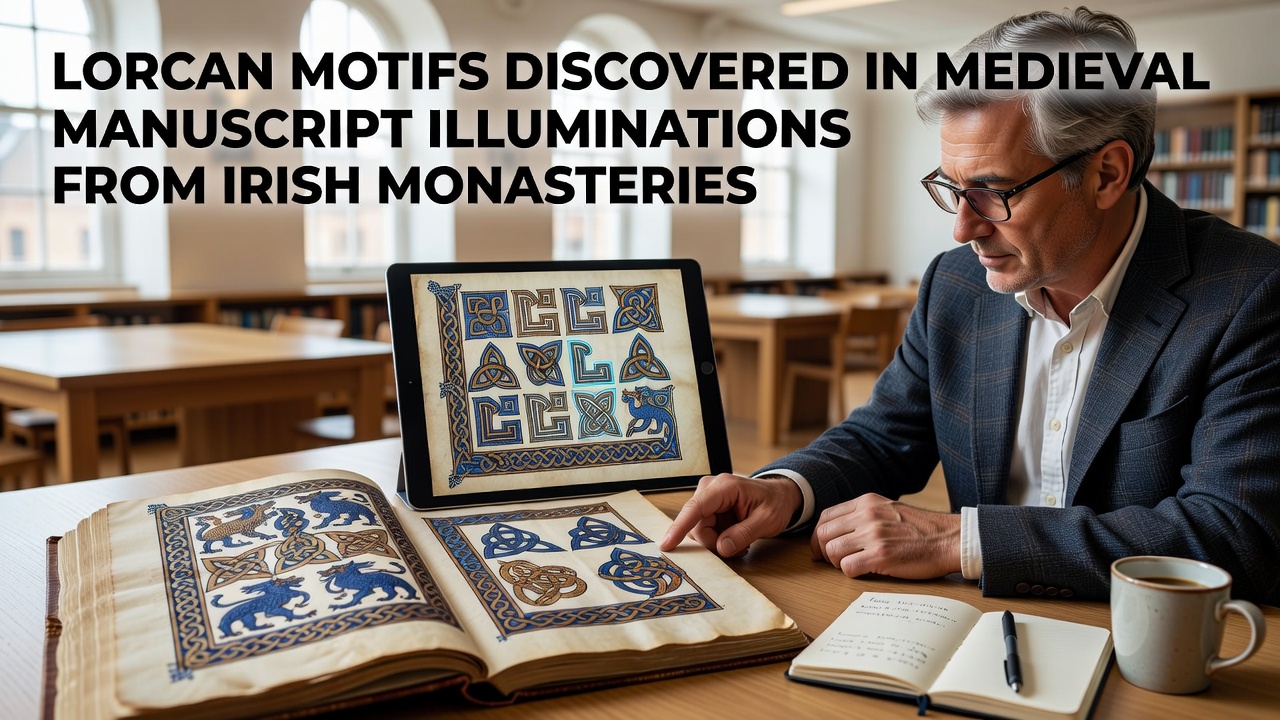
Irish monasteries produced some of the most intricate illuminated manuscripts in early medieval Europe, and recent examinations have identified recurring decorative elements now termed Lorcan motifs after patterns observed across multiple codices from sites including Clonmacnoise and Kells. These motifs combine interlace bands with stylized animal forms and geometric knots that repeat in marginal decorations and initial letters, and scholars trace their development through carbon-dated vellum samples spanning the eighth to eleventh centuries.
Origins in Monastic Scriptoria
Monks working in scriptoria along the Shannon and Boyne river valleys developed distinctive illumination techniques that incorporated local artistic traditions with influences arriving through pilgrimage and trade, while the Lorcan motif appears as a standardized design unit that allowed scribes to fill space efficiently without disrupting the flow of Latin text. Researchers at Trinity College Dublin have catalogued over forty instances where the same spiral-and-interlace sequence frames Gospel incipits, and analysis shows consistent pigment recipes using lapis lazuli imported from Afghanistan alongside native ochres and carbon blacks.
Excavations at monastic sites continue to yield tools and pigment pots that match the materials found in surviving pages, yet the motifs themselves remain the strongest evidence of shared workshop practices across different foundations. One study published by University College Cork mapped the distribution of these designs and found that the core structure of the Lorcan motif remains stable even when surrounding decorative programs vary by regional workshop.
Characteristics and Variations
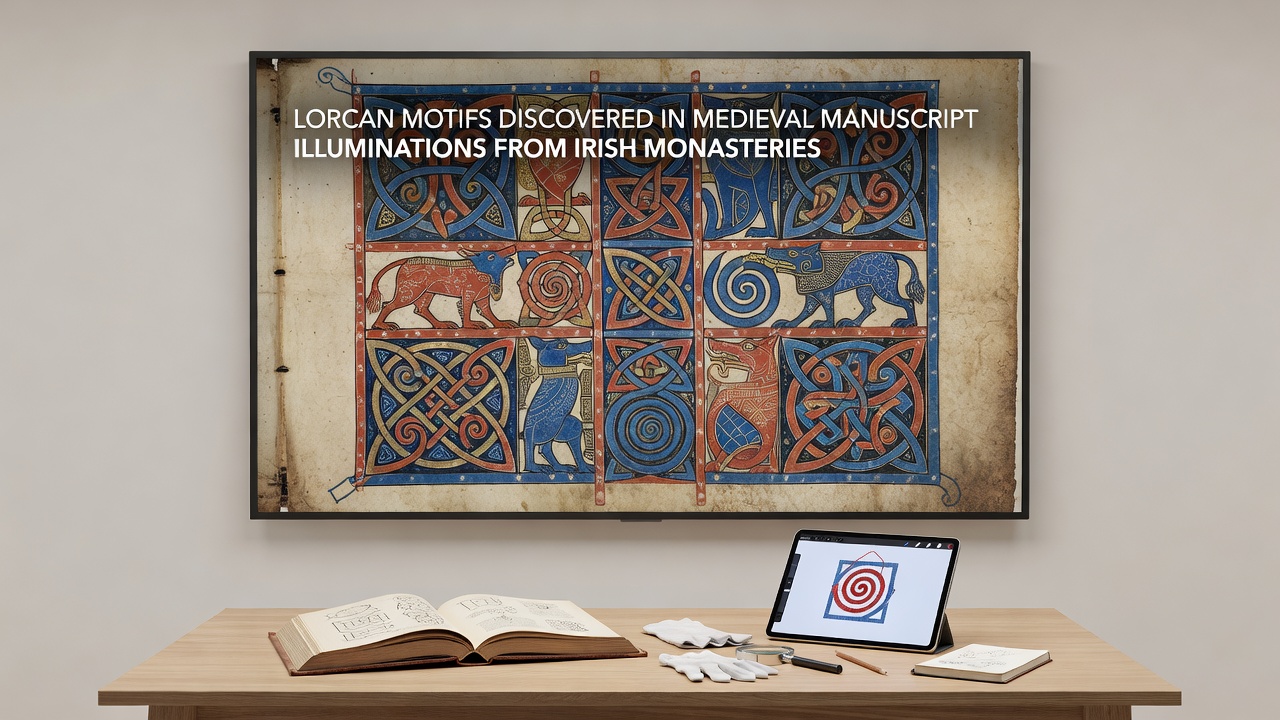
The Lorcan motif typically consists of a central boss formed by three interlaced ribbons that terminate in stylized bird or serpent heads, and these elements repeat at regular intervals along borders or within the bowls of large capital letters. Infrared imaging has revealed underdrawings that indicate scribes planned the placement of each motif before applying gold leaf or colored inks, while later additions sometimes overlay earlier versions with slight shifts in proportion.
Manuscripts such as the Book of Kells and the Lindisfarne Gospels contain early examples, but the motif also appears in lesser-known fragments held in European libraries. Art historians note that the density of the interlace increases in later examples from the tenth century, suggesting an evolution in technique that may reflect changing liturgical needs or the availability of finer quills.
Analytical Methods and Recent Findings
Multispectral imaging and X-ray fluorescence have allowed conservators to distinguish original layers from later restorations, and these techniques have confirmed that the Lorcan motifs were executed in a single campaign rather than added piecemeal over generations. In September 2026 the Royal Irish Academy hosted an international workshop where teams presented new digital reconstructions of faded pages from the Book of Durrow, revealing previously invisible motif outlines beneath flaking pigment.
Comparative studies with continental manuscripts housed at the Bibliothèque nationale de France have shown parallel but not identical designs, indicating that Irish scribes adapted the motif for local vellum sizes and ruling patterns. Data from the Corpus of Electronic Texts project at University College Cork further documents references to similar decorative conventions in contemporary annals, although textual descriptions remain sparse compared with the visual evidence.
Implications for Manuscript Studies
Recognition of the Lorcan motif as a distinct design unit has prompted re-examination of workshop hierarchies, because the consistency of execution suggests that master illuminators trained apprentices in its production across multiple sites. Museum collections in Ireland and abroad have begun updating catalogue entries to note the presence of these motifs, which aids researchers tracing the movement of individual scribes between foundations.
Conservation teams at the National Museum of Ireland report that identifying the motif helps prioritize which damaged folios receive immediate treatment, since the repeated structure allows partial reconstruction of missing sections from surviving counterparts elsewhere in the same volume. Academic databases maintained by European research consortia now tag entries with motif classifications, speeding up cross-referencing for scholars studying Insular art traditions.
Conclusion
The identification of Lorcan motifs provides a concrete framework for understanding decorative unity across Irish monastic manuscripts, and ongoing digitization projects continue to bring new examples to light. Continued collaboration between conservators, historians, and imaging specialists promises further refinement of the motif's chronology and geographic spread, while the surviving pages themselves remain the primary record of the technical skill and artistic coherence achieved in those scriptoria.